“That’s What the Right Would Say”
~ Conversation Edges, the Left, and Playfulness

By Muzammal Hussain
Introduction: Celebration and Hope
The UK by-election result in Gorton-and-Denton was a pivotal moment. The caring, genuine, working class Hannah-the-plumber is now the Green Party’s fifth MP. The narrative of establishment politics seems to have ruptured, and there are signs of a fresh spirit of collaborative politics emerging amongst progressives.
Hope is alive.
As well as electoral politics, there is also the wider grassroots picture with hundreds of different groups: socialists, anarchists, NGO's, faith groups and so forth.
“The challenges of the polycrisis - the climate and ecological crisis, the cost of living crisis, and the rise of authoritarianism, for instance - require us to dig deep, right now and with others.”
Yet, our ideas, vision, or approach may not be exactly the same. So, how do we navigate our differences when we need each other and cannot do this alone?
This article is written in the spirit of the inevitably of difference, and the recognition of how much it can enrich especially when we are able to commit to working deeply.
This article is also about ‘belonging’ and the cultivation of community as core ingredients for a new society that embodies a more radical democracy.
When explorations have boundaries
In the spirit of meeting the possibility that hope offers, I start with an observation related to interactions within the ‘left’. It is one that I know others share, yet does not seem to be given enough of the right kind of attention.
With some exceptions, one of my observations when interacting with many strongly identifying as ‘on the left’, is there is often little willingness to explore views outside a narrow bandwidth.
“Instead, despite believing in diversity and inclusiveness, there can be premature judgement and a scarcity of curiosity and imagination, reinforcing brittle boundaries limiting what we are ‘allowed’ to explore.”
The response to a different view, presented perhaps over a coffee, or at a social, might be something like, “that’s what the right would say”. Another response, in the context of closing off an exploratory conversation might be, “we should be united and fight the right”. It is as though unity is only possible if we hold almost exactly the same view, or focus only on a ‘common enemy’.
This may then be followed by a mini-lecture on what we should all be believing and doing as we ‘fight the right’, as though it is gospel, and then with little invitation to hear a response.
The person on the receiving end of this mini-lecture might then be left feeling frustrated, unheard, and with less connection to a movement that is supposed to care. If this person cannot explore their genuine views and feelings in the space of ‘progressives’, where are we implicitly asking them to go, given the core human need, ‘to belong’?
“It is as though we are a monoculture forbidden from openly listening to our differing perspectives, from hearing the stories behind them and as a result appreciating one another more. ”

Photo Credt: Sherman Trotz Via Pexels
While I do believe we need be mindful as to how, and where, we have what exploratory conversations, because of how something might get misrepresented, we also need to be mindful that our words and certain rigid boundaries might silence authentic voices who wish to engage in genuine dialogue and reflection; or that our words might stilt a fellow comrade’s explorations of making sense of the world.
“For we do not *compost patriarchal structures externally and within ourselves when we silence genuine, curious voices within our movement, stunting their expression, and our mutual evolution and growth. ”
So, while the well intended motive might be to maintain unity, how can unity ever be real or sustained, when we push down ideas that are genuinely shared? Change is rarely linear, and without explorations of, and beyond, the edges of what we assume to be part of our identity, our opinions and positions will become stale and parroted. We will develop unexplored blindspots, be sidelining empathy and creating a world that also does the same.
At the same time, I need to stress that should I be bringing forward a different perspective, I too have a responsibility. I would need to consider, Am I sharing this out of a sincere intention to explore, and from a place of mutual humanising? Or am I trying to create toxicity or be hostile? For the latter, receiving a response that asserts a boundary might certainly be fitting. For the former, a doorway for real dialogue has appeared...
When the chosen path will be hardest
“Sometimes I hear a certain envy on the left. “Why is the left always fighting amongst itself, when the right is united?” we might say. ”
Some of my reflections on this envy, leaving aside that I believe it to be only partially true, is that while the right can come together to unite against certain groups (e.g. refugees, Muslims, people of colour etc..), the path for progressives is deeper and not meant to be the same. It will be harder, more authentic, more transformative and longer than the path available to those far on the right, of being united through scapegoating another group - while distracting from the reality of wealth concentrated amongst a few, and from whom the right receives much support.
This harder, more transformative path is one I believe we need to be walking steadily on, even as we engage with essential organising, strategies and actions along the way. In doing so, the outward organising for a world that cares for all will be enriched through what we have gained. Whereas bypassing this path to focus only on short term actions, fuelled by our felt perpetual ‘urgency’ in fight/flight mode, will limit any depth to our progress.
The path of building a society that cares for all must include conscious relating, listening to stories, giving space to the imagination, and making collective decisions through a diversity of perspectives genuinely shared as opposed to seeing them as an obstacle to bypass and suppress.

Photo Credit: Gurtrood-Via-Pixabay--rabbit-4635956_1280
“This path I am talking about calls us to - at times at least - loosen our identification with our beliefs, and be willing to consider the truth in another’s. ”
While this may be unsettling because we are now stepping into something of an inner unknown, it allows all parties to be given space, to be heard and to be enriched.
We have shifted from a mode of ‘evaluation and oppositionality’ to one of ‘curiosity and dialogue’. Even if after these such moments, each of our respective perspectives remains essentially the same, our appreciation for one another will be enhanced in subtle ways. We will also, in the way we are relating, be building the qualities of community that embody the world we wish to co-create.
While this may not be in each of our capacities in a given situation, I believe in its more radical, inclusive form, this path also involves an active effort to humanise those whom we ‘oppose’ even as we might resist their actions. With this intention and effort we start to break the spell of polarisation, and enter into the spirit of activism embodied by people such as the late Nelson Mandela.
Thus, this is a path that is both more challenging and enriching. It is more challenging because it requires us to undo habitual patterns of relating we are accustomed to. It asks us to give attention to aspects of our own conditioning. It is a path of change-making on which internal and relational liberation is as much a component of the work as the liberatory work we engage with out there. The reward gained is that the potency of each is enhanced.
Drawing chosen approaches into our support system
“If we are serious about this path, some questions that arise might be, ‘what can help further me on this journey?’, or ‘what do we need so we can grow in a way that is needed for our individual and collective liberation?’ ”
In a partial response to these questions, I’d like to speak something of the current leader of the Green Party. I am not a Green Party member but I have voted Green for at least the last twenty five or so years in general elections, even when I was campaigning for Corbyn’s Labour party nationally in 2017 and 2019 (I live in Brighton Pavilion where our MP was the amazing Caroline Lucas, and since 2024 has been Sian Berry, both Greens).
I was hopeful when Zack Polanski announced he was standing in the Green Party leadership race, as I had been impressed by his holistic, down-to-earth, clear responses to questions in past interviews (e.g. on Novara media). Also, as he stepped into the leadership race, he hit the vacant magic note increasingly on offer, articulating a vision of wealth redistribution, funding public services, changing the narrative on asylum seekers, while boldly speaking against the UK’s complicity with Israel’s war crimes and genocide in Gaza. (He did not proactively talk about the ecological crisis as that was implicit, being the Green party(!), and many people had more immediate struggles he wanted to directly acknowledge).
There are many things about Zack I could complement. I want to focus on ‘relating to difference’.
I have seen Zack take both a firm stance, when needed, and be open to genuine dialogue.
I see his listening skills as exemplary: he seems to listen deeply, welcoming the words he hears, and he is able to respond with a respectable degree of depth and wisdom, even under pressure. This quality is particularly evident in interactions structured to give more space, such as his podcast ‘Bold Politics with Zack Polanski’.
How did he develop this capacity?
It was in his interview with Rory Stewart and Alistair Campbell around the end of 2025 that it clicked for me. In the interview, Zack talked about his background, and mentioned working with an approach called ‘Theater of the Oppressed’. (25 minutes into the video).
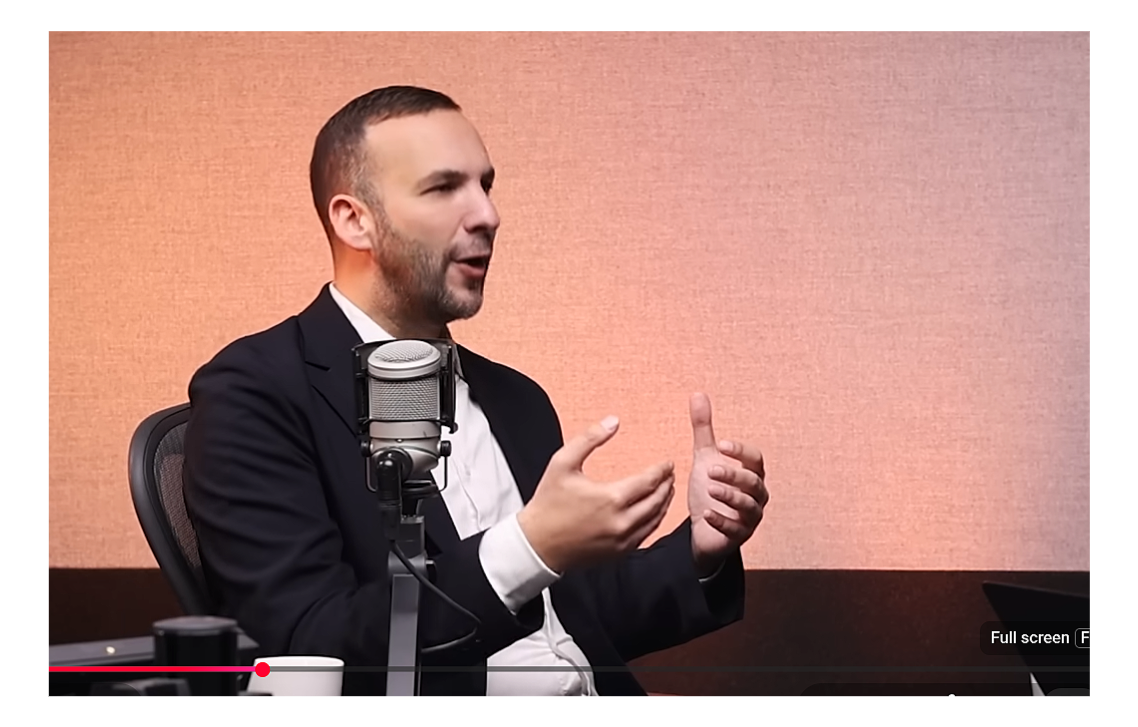
Things began to then make more sense to me. I took part in ‘Theatre of the Oppressed’ many years ago through Wisdom In Nature, where it was introduced by a fellow member who had trained in this liberatory approach. I found it both playful and potentially very potent.
‘Theatre of the Oppressed’ was developed through the work of the Brazilian theatre practitioner, drama theorist, and political activist, Augusto Boal. It incorporates different tools or techniques, and one way it is expressed involves actors entering a community to act out a scene of oppression shared by that community.
The audience watching the scene are called ‘spect-actors’ (not spectators), as they would soon participate in the scene through acting.
If one of the spect-actors has an idea as to how the oppressed role(s) in the scene could be played differently, rather than say what their idea is, they are instead invited to step into the scene and play that role! The scene will then play out, leading to a potentially different outcome.
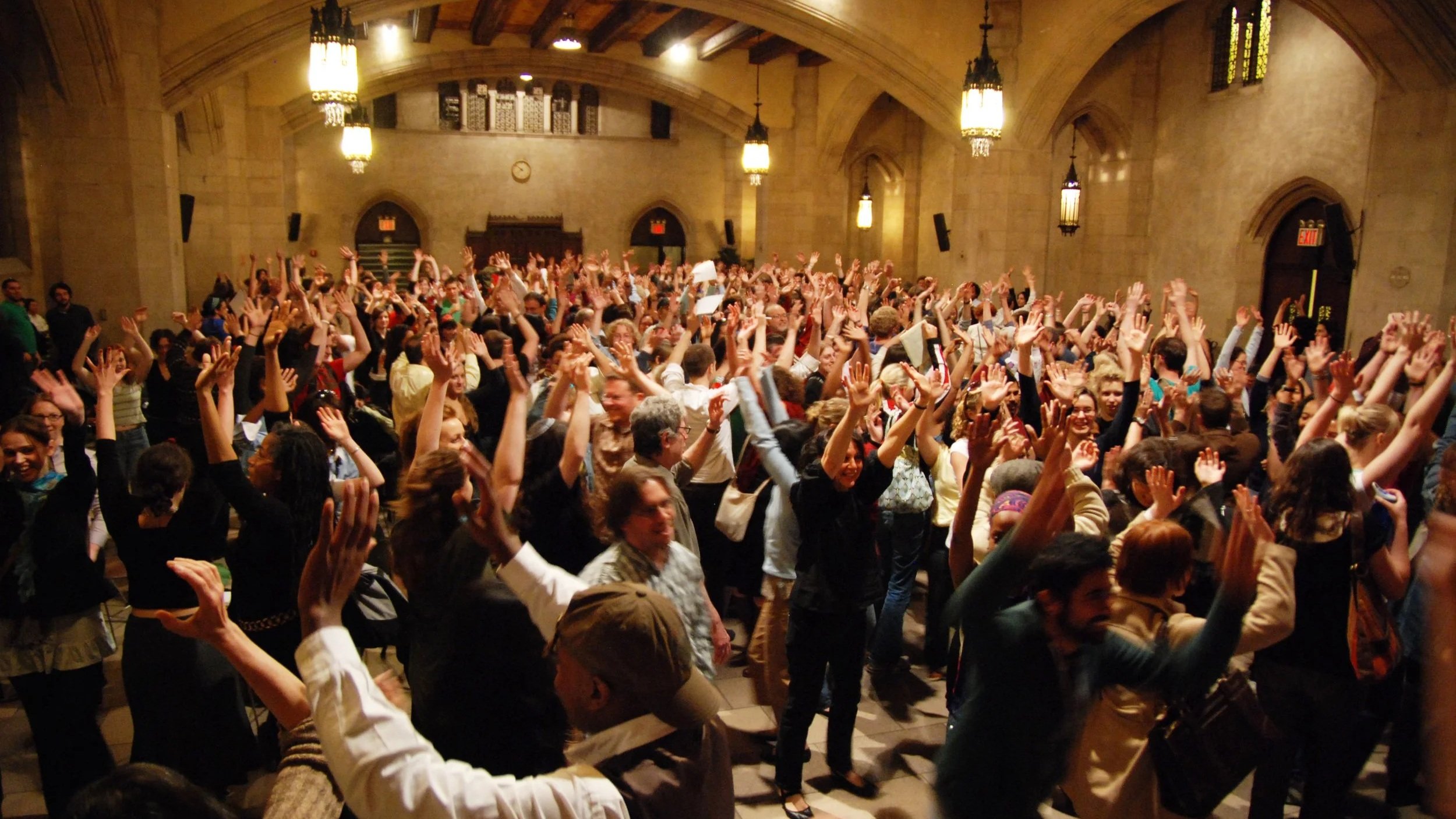
Photo Credit: By Thehero - Own work, CC BY-SA 3.0, https://commons.wikimedia.org/w/index.php?curid=6717882
In my own experience of ‘Theatre of the Oppressed’, even if I have stepped forward to implement an idea, I will also witness other ‘spect-actors’ who wish to have a go. Together we see the impacts of all these ideas being implemented. We thus all begin to witness different possibilities, beyond the one initially presented, and beyond our own. We will also have been orienting to the oppressor in our efforts to relate consciously to them so that our idea might be more effective
Our stories that have passed
Zack, a gay, Jewish man, has described numerous experiences that have helped shape him.
“My sense is that his background in theatre, and perhaps especially ‘Theatre of the Oppressed’, has helped strengthen his ability to step into the shoes of another and to engage in creative ways”
Such a practise would help someone better able to resolve a relationally tense or potentially violent conflict or encounter.
While oppression can be a more extreme manifestation, there are many different situations of difference. The playful nature of exploring these dynamics with different interventions will enhance our ability to step into another’s shoes, exercising our relational muscles, and helping towards a more wholesome outcome.
Of course, anyone with a noticeable ability to engage maturely with difference will have their own unique story that has shaped them. Similarly, our opinions will also have arisen from our unique stories. That is why I am, in many ways, as interested in people’s stories and how that shaped their perspectives, as hearing their present day perspective itself.
“For stories give meaning, and when we hear them without judgement, our appreciation and understanding of one another is enriched.”
Experimentation, the imagination and playfulness
“People are seeking spaces where they can truly belong, where all parts of them are welcome, and this goes beyond having a common enemy or opposition.”
So I am keen for us progressives to experiment with playful approaches… and with playfulness, we are less likely to burnout.
It is of course not only ‘Theatre of the Oppressed’. There are other approaches and experimentations being done as to how we can work better with difference. There is Nonviolent Communication (NVC) with a focus on language and connection, and Process Work that intentionally includes awareness of rank and power dynamics, to name a couple. These might also embrace role-play or stepping into roles, which can open us to less explored territories in our internal landscape and help loosen the boundaries of our identity, if only for a few moments.
Then there are interactive facilitation tools used in some grass-root groups, to varying degrees of depth, that also encourage occupying roles and reflecting on experiences in doing so.
It needs to be said that none of these approaches are silver bullets, and any approach is susceptible to being applied dogmatically, yet each can point to a direction that can help make the path more visible.
Our stories to be written
“I believe that if any movement is truly progressive, is truly visionary in building a new inclusive society, it needs people cultivating the awareness and skills in how to engage with those who hold views that are different to our own, even if those views unsettle us. ”
This work, if it is meaningful, is deeper than simply having a ready-made response or argument, but involves curiosity, activating the imagination and seeing the world through another’s eyes.
Through this deep, engaged work, we will increase our collective capacity for dialogue, be enriched by authentic, well meaning voices, and create room for our outer work to evolve, deepen and transform.
So, here’s to the imagination and playfulness as a serious and welcome component of our progressive movement.
Here is to the nourishing of our ongoing growth and sense of authentic belonging, as we experience transformative change on this path of individual and collective liberation.
Not only is this a movement I would want to stay in, in this world of so much isolation, it is one I would want to be part of if I was outside it.
—
* In this sentence I use the term ‘compost patriarchal structures’, rather than ‘fight (or smash) patriarchal structures’, for instance, because ‘compost’ is more aligned to the idea of transformation. It holds the reality that the energy in systems, even in toxic systems, cannot just disappear. Yet, these systems can be ‘composted’ or transformed such that the energy released is channelled into more life supportive functions. This is similar to garden waste. If it lies around it can become toxic and smell foul. Create the right conditions, it will compost and provide nutrients for plants that can further feed and support a range of other life including human life and human well-being.
—
Author Bio
Muzammal Hussain has been involved with grassroots change-making for more than 25 years, and is the lead trainer for WiN's Sacred Collaborative Leadership (SCL) programme.
Muzammal has supported teams (such as a refugee self-support group, grassroot cooperatives, and faith groups) with collective decision-making, conflict processing or collaborative organising. He draws on liberatory approaches that support shared power, such as Sociocracy (which includes consent-based decision-making), Process Work, Non-Violent Communication (NVC) with a systemic lens and Social Permaculture. He emphasises presence and embodiment, and sees his role as both a trainer and a life-long student.
He works both through Wisdom In Nature, and independently at Restorative Wholeness
With the latter, Muzammal has over twenty years experience helping people safely process trauma through a potent essence-based somatic healing therapy. He is the author of 'Radical Healing, Wholeness and Islam', as well as an NHS medical doctor in the field of psychiatry for more than fifteen years.
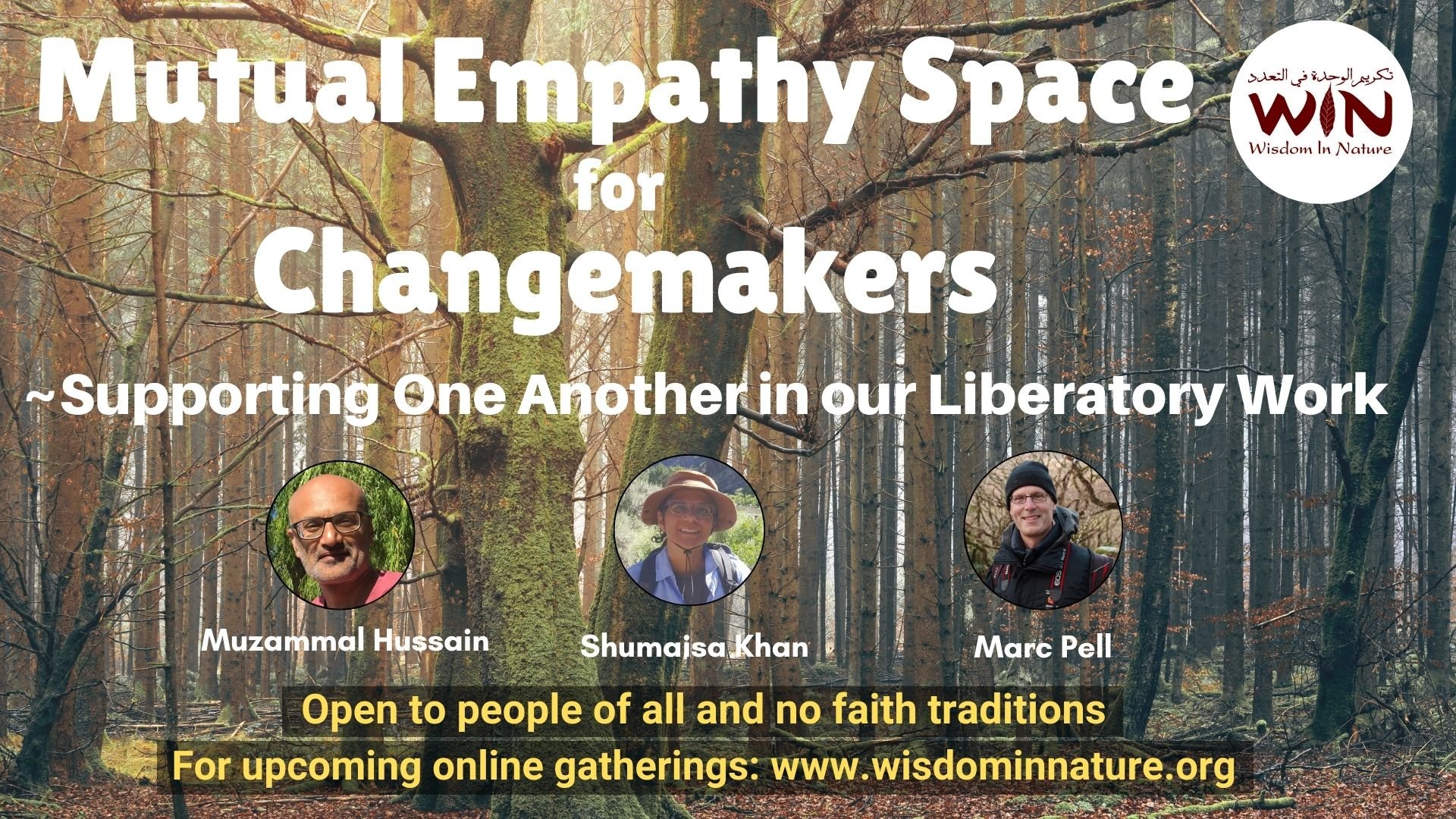
Join WiN’s Mutual Empathy Space for Changemakers, with Muzammal Hussain and friends
As change-makers we know that organising with fellow travellers for transformational change will involve challenging moments, feelings of tension, moments where we become ‘activated’.
The Mutual Empathy Space is about supporting one another in our liberatory work.
Some benefits:
Connect with fellow change-makers in a conscious space
Receive mutual care for your change-making work - help prevent burnout!
Enhance your effectiveness in transformational change-making
For more Info about the Mutual Empathy Space and
Dates of Upcoming Online gatherings click here!